
To be a game ranger in an African game reserve was a dream that I fulfilled in my younger years.
When I emigrated to South Africa, I landed a job within a month and lived a life similar to that in Europe. However, my primary interest was in nature. To explore it, I needed my job and the corresponding income. My fascination with Africa’s wilderness and wildlife had always been a part of me. One day, I decided to pursue a relevant education in South Africa. With the certificate I earned, I could work as a guide on the African continent and face the challenges of nature.
Training as a Game Ranger
I started training as a game ranger. The final survival week took place near Phalaborwa, a place renowned for its impressive baobabs and sturdy Mopani trees. The wood of the Mopani tree is among the heaviest and hardest in southern Africa. It is so robust that even termites fail to penetrate it and avoid these trees. Thus, this wood is often used for building houses and fences.
The characteristic leaves of the Mopani tree serve as food for the Mopani caterpillar, which later transforms into the magnificent brown emperor moth (Gonimbrasia belina). These Mopani worms are a delicacy, generating millions of Swiss francs in annual revenue for the economy. The caterpillar’s innards are first squeezed out, then fried with onions and enjoyed with mieliepap (a type of polenta made from white maize).
The Harshness of the Bush: Daily Survival, Eat or Be Eaten!
Surviving in the bush is extremely tough, especially if you’re accustomed to the comforts of modern life. The nights were cold, and the days were relentlessly hot. Temperature differences of 30º Celsius between day and night were not uncommon. The sounds of the wilderness became my constant companion. Just before sunrise, when the light was sufficient to see my surroundings, I would head to the riverbed with a water sack, a water container, and a shovel, although it was mostly dry.
The water sack was for showering, needing 7 to 8 liters of water. I would wet myself briefly, soap up, and then rinse off the soapy water. This taught me to conserve water, a habit I still maintain today. The water in the container was meant for cooking and drinking and had to be filtered. It often took over two hours to dig a hole in the riverbed and collect a sufficient amount of water. The hard work was made more difficult by large stones that constantly impeded progress. But once dug, I thought I could reuse the waterhole repeatedly.
The Unexpected Guests
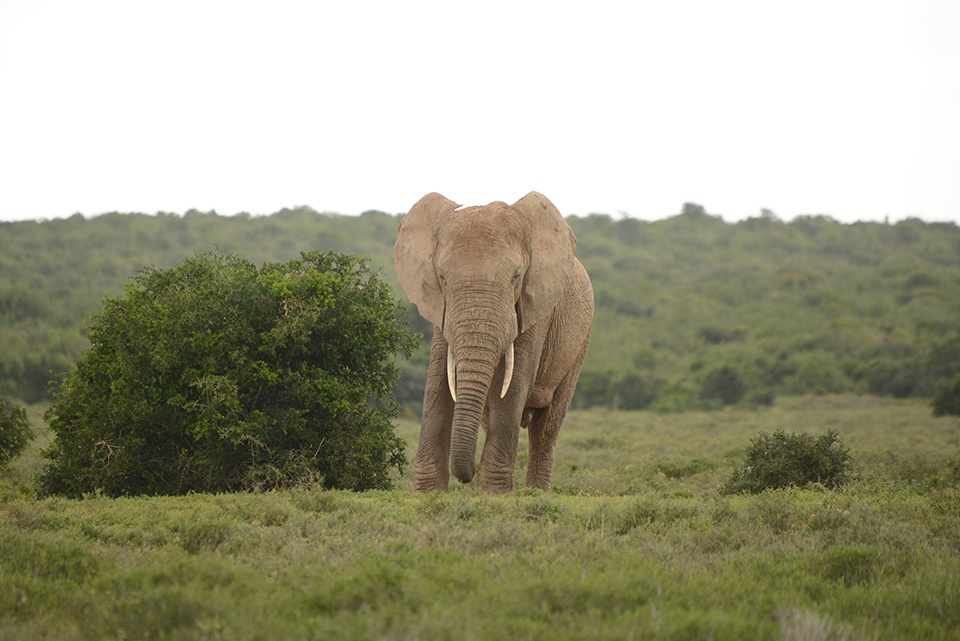
The next morning, when I wanted to fetch my daily water ration, a massive bull elephant had taken over my waterhole, my hard-earned water source. He looked at me as if to say, »I was here first!« That was true, but I had dug the hole, so it was my waterhole. I watched him for a long time, hoping he would move on and leave me some water. Unfortunately, a second and third elephant joined him. The giants stood languidly in the morning sun, happily drinking the water I had worked so hard to get. I had no choice but to dig a second hole, further away.
As I dug again, the three elephants watched me with interest. Their curiosity seemed insatiable, and I was convinced they were already planning to claim this waterhole too. It was clear that I had no chance of keeping the water from them.
The Beauty of the Wilderness
But did I really want a chance? With each spadeful of earth, I realized that I was one with nature. The challenges of surviving in the bush made me stronger and taught me humility. The tranquility, the wilderness, and the scent of the elephants became integral parts of my life. Elephants have a distinctive smell, sweet and earthy at the same time, and I enjoyed photographing them at my waterhole.
The elephants didn’t just take my water; they gave me something in return: a deep connection to nature and an unparalleled experience that enriched my life. Their majestic presence and calm demeanor taught me patience and respect for nature.
Life as a game ranger was a journey full of adventures and unexpected lessons. Every day brought new challenges and surprises that taught me to live in harmony with nature. The elephants that claimed my waterhole were more than rivals; they were teachers who showed me how to live in harmony with my surroundings.
These experiences continue to shape my life. The awareness of nature’s beauty and challenges has taught me to live more sustainably and respectfully. I am grateful for every minute spent in the wilderness and for the wisdom I gained from the elephants and other bush inhabitants.
This is real life in and with nature—an experience I highly recommend to everyone.

