A road trip with Kurt through South Africa:Discover the Garden Route!

A road trip with Kurt through South Africa:
Discover the Garden Route!

South Africa has an incredible variety of beautiful landscapes to offer, and one of the most famous is the Garden Route. A drive along this stunning route is one of the absolute highlights of a South Africa trip. Here you will learn why you should definitely experience this spectacular route and what sights, activities, and culinary delights await you on your road trip.

The Route: From Cape Town to Port Elizabeth

The Garden Route stretches from Mossel Bay in the Western Cape province to Storms River in the Eastern Cape province and covers approximately 300 kilometers. You can start your journey in Cape Town and travel either along the coast or through the interior of the country to the east, or from Gqeberha (Port Elizabeth) to Cape Town, thus heading west. The route takes you through beautiful landscapes, from mountains, forests, and beaches to lagoons and river estuaries. It is a drive that rewards you with breathtaking views and fascinating natural wonders.

The Sights Along the Route

The Garden Route is known for its natural beauty and there are numerous breathtaking sights to discover along the route, depending on your personal interests and tastes. Highlights include the Knysna Heads, a fascinating natural spectacle where two rocks divide the sea, the Tsitsikamma National Park with its picturesque hiking trails, and the Bloukrans Bridge Bungee, the highest bungee jump in the world.

Outdoor Adventures on the Garden Route

For all adventurers and outdoor enthusiasts, there are numerous activities on the Garden Route that will get your adrenaline pumping. One option is kayaking along the coast or hiking to the summit of Table Mountain. A hike through the Tsitsikamma National Park or a dive in one of the many coastal waters of the region can also be an unforgettable experience.

Culinary Highlights on the Garden Route

The Garden Route in South Africa has a lot to offer in terms of cuisine. The region is particularly known for its fresh seafood, which is served in numerous restaurants along the route. The selection is diverse, ranging from oysters and lobsters to prawns and mussels. If you are looking for a special culinary experience, you should visit the famous Knysna Oyster Festival. Every year in July, during the South African »winter«, everything revolves around the delicious oysters that come from the waters off the coast of Knysna. There are numerous stands where you can enjoy the freshest oysters and other seafood.

In addition to seafood, there are also numerous award-winning wineries on the Garden Route, where you can taste the best South African wines. The wineries near Stellenbosch and Franschhoek are particularly recommended, known for their excellent wines and beautiful landscapes.

Accommodation on the Garden Route

There are a variety of accommodations along the Garden Route, from personal bed and breakfasts and guesthouses to luxurious hotels and villas. If you like to stay in nature, you can also stay in one of the numerous national parks along the route.

One of the most famous accommodations on the Garden Route is the Phantom Forest Eco Reserve in Knysna. Here you can stay in luxurious treehouses and enjoy the breathtaking views of the Knysna Lake and the surrounding forests. The Fancourt Hotel in George is also a popular accommodation on the Garden Route. The hotel has three award-winning golf courses and a spa that invites you to relax.

Travel Tips for an Unforgettable Road Trip on the Garden Route

To make the most of your road trip on the Garden Route, there are a few important things to keep in mind. Here are some travel tips that will help you make your trip unforgettable:

Plan enough time: The Garden Route is a beautiful route and there are many sights, activities, and restaurants to discover along the way. Therefore, plan enough time to be able to experience everything in peace.

Rent a car: To experience the Garden Route, you will need a car. There are numerous car rental companies in Cape Town and Port Elizabeth from where you can start your journey.

Be flexible: The Garden Route is known for its changing weather conditions. Therefore, be flexible and plan your activities accordingly.

Pack comfortable clothing and shoes: On the Garden Route, there are numerous hiking trails and activities that require comfortable clothing and shoes.

You can find even more insider tips in my checklist for traveling to South Africa!

Conclusion

South Africa is a fascinating country with an incredible variety of landscapes, cultures, and experiences. From the endless beaches along the coast to the majestic mountain ranges in the interior, there is a lot to discover in South Africa. The country also has an incredibly rich history and culture that is reflected in its cities, museums, and monuments. Particularly noteworthy is the diverse population of the country, which consists of a mix of African, European, Asian, and other cultures.

In addition to its nature and culture, South Africa also offers a very tasty cuisine that is shaped by its diverse population. Although the country’s cuisine is best known for its seafood and wines, there are many other local specialties that you should definitely try.
Overall, South Africa is a fascinating country that is definitely worth a visit. Whether you are looking for adventure, culture, or relaxation, South Africa has something to offer for everyone and will surely impress you.

My eye-opening adventure as a game ranger in South Africa

My eye-opening adventure as a game ranger in South Africa

To be a game ranger in an African game reserve was a dream that I fulfilled in my younger years.

When I emigrated to South Africa, I landed a job within a month and lived a life similar to that in Europe. However, my primary interest was in nature. To explore it, I needed my job and the corresponding income. My fascination with Africa’s wilderness and wildlife had always been a part of me. One day, I decided to pursue a relevant education in South Africa. With the certificate I earned, I could work as a guide on the African continent and face the challenges of nature.

Training as a Game Ranger

I started training as a game ranger. The final survival week took place near Phalaborwa, a place renowned for its impressive baobabs and sturdy Mopani trees. The wood of the Mopani tree is among the heaviest and hardest in southern Africa. It is so robust that even termites fail to penetrate it and avoid these trees. Thus, this wood is often used for building houses and fences.

The characteristic leaves of the Mopani tree serve as food for the Mopani caterpillar, which later transforms into the magnificent brown emperor moth (Gonimbrasia belina). These Mopani worms are a delicacy, generating millions of Swiss francs in annual revenue for the economy. The caterpillar’s innards are first squeezed out, then fried with onions and enjoyed with mieliepap (a type of polenta made from white maize).

The Harshness of the Bush: Daily Survival, Eat or Be Eaten!

Surviving in the bush is extremely tough, especially if you’re accustomed to the comforts of modern life. The nights were cold, and the days were relentlessly hot. Temperature differences of 30º Celsius between day and night were not uncommon. The sounds of the wilderness became my constant companion. Just before sunrise, when the light was sufficient to see my surroundings, I would head to the riverbed with a water sack, a water container, and a shovel, although it was mostly dry.

The water sack was for showering, needing 7 to 8 liters of water. I would wet myself briefly, soap up, and then rinse off the soapy water. This taught me to conserve water, a habit I still maintain today. The water in the container was meant for cooking and drinking and had to be filtered. It often took over two hours to dig a hole in the riverbed and collect a sufficient amount of water. The hard work was made more difficult by large stones that constantly impeded progress. But once dug, I thought I could reuse the waterhole repeatedly.

The Unexpected Guests

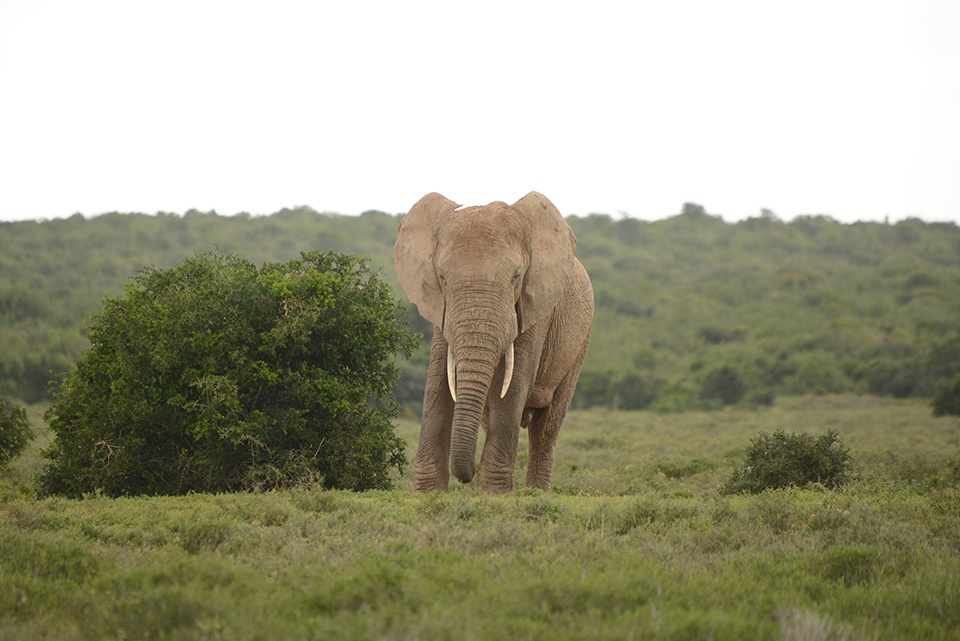
The next morning, when I wanted to fetch my daily water ration, a massive bull elephant had taken over my waterhole, my hard-earned water source. He looked at me as if to say, »I was here first!« That was true, but I had dug the hole, so it was my waterhole. I watched him for a long time, hoping he would move on and leave me some water. Unfortunately, a second and third elephant joined him. The giants stood languidly in the morning sun, happily drinking the water I had worked so hard to get. I had no choice but to dig a second hole, further away.

As I dug again, the three elephants watched me with interest. Their curiosity seemed insatiable, and I was convinced they were already planning to claim this waterhole too. It was clear that I had no chance of keeping the water from them.

The Beauty of the Wilderness

But did I really want a chance? With each spadeful of earth, I realized that I was one with nature. The challenges of surviving in the bush made me stronger and taught me humility. The tranquility, the wilderness, and the scent of the elephants became integral parts of my life. Elephants have a distinctive smell, sweet and earthy at the same time, and I enjoyed photographing them at my waterhole.

The elephants didn’t just take my water; they gave me something in return: a deep connection to nature and an unparalleled experience that enriched my life. Their majestic presence and calm demeanor taught me patience and respect for nature.

Life as a game ranger was a journey full of adventures and unexpected lessons. Every day brought new challenges and surprises that taught me to live in harmony with nature. The elephants that claimed my waterhole were more than rivals; they were teachers who showed me how to live in harmony with my surroundings.

These experiences continue to shape my life. The awareness of nature’s beauty and challenges has taught me to live more sustainably and respectfully. I am grateful for every minute spent in the wilderness and for the wisdom I gained from the elephants and other bush inhabitants.

This is real life in and with nature—an experience I highly recommend to everyone.

How the escapades of a tourist almost spoiled my wilderness adventure

How the escapades of a tourist almost spoiled my wilderness adventure

In June 1979, in the Okavango Delta in Botswana, I experienced for the first time in my life, how some humans have forgotten that they are also a part of nature.

After our daring flight, Pierre and I unpacked our belongings from the aeroplane, greeted the other guests and our hosts at the main camp and took up our tents. The plan was to leave the main camp for four nights and to »glide« through the swamps with the mokoros for our photo safari.

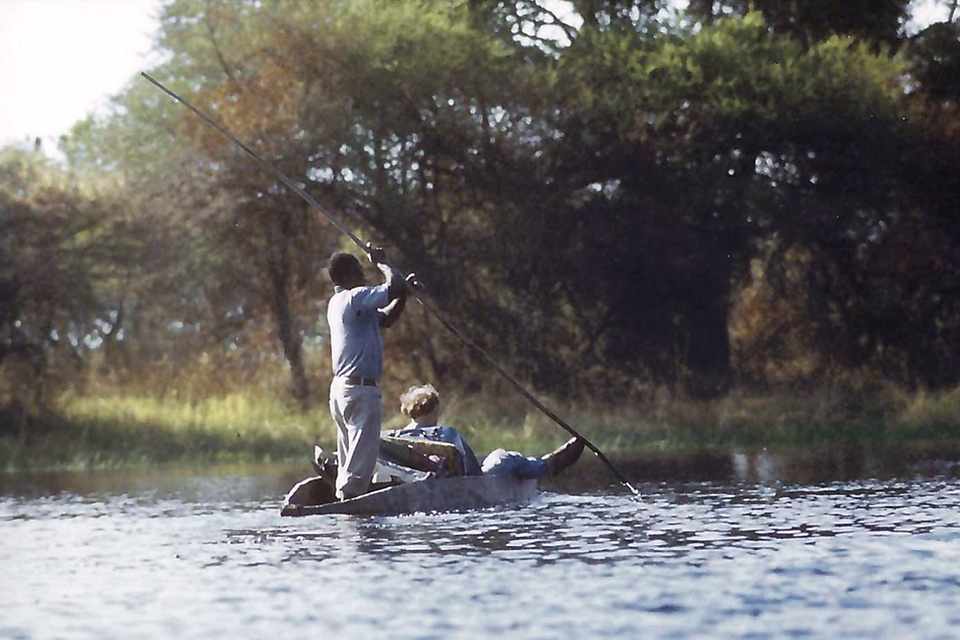
A mokoro is a dugout canoe about four meters long, made from the liverwurst tree and guided by a boatman with a long stick.

The biggest advantage over safari by off-road vehicle is that you make very little noise on the water and thus the animals do not perceive it as a threat. The locals have been using this means of transportation for generations. The disadvantage is that it is advisable to follow the smaller water channels mainly between papyrus and countless spider webs. The main, larger, and deeper waters are the habitat of the hippos and the Nile crocodile, which we respect.

We were asked by the manager if we would be so kind and take a lady with us. She was alone, heartbroken, just out of a relationship and she didn’t know how she wanted to spend her holiday.

We had taken food for six people, then it would probably be enough for seven. In facts, I felt sorry for her, I discussed the matter with my friends and we confirmed the lady’s wish.

We packed an additional mokoro with our equipment and food and off we went into the adventure, being one with nature, far away from everyday life and civilization.

During the trip with the mokoros, »my« guest kept herself the whole time hidden under a jacket. She was afraid of spiders and the spider webs were very disturbing for her.

Upon arrival on an island, we unpacked our goods and started, while it was still light enough, to set up our tents and make everything ready for the night. Of course, the lady did not help. Oh no, that’s a man’s job!

Later that night, I wanted to get some sleep too and I opened the zip to enter my tent. To my great surprise, the lady refused me to come in. No way, she said, shall I be sleeping next to her! So, I slept on the bare ground – my foam mat was under the lady in the tent – next to the fire under the starry sky.

The next morning the lady was up at sunrise. She did her cat-wash and washed her hair at the riverbank. Afterwards she asked where she could plug in her hair dryer and was quite surprised that we had not brought a generator in the extra mokoro. Fortunately, there was no smartphone at that time, otherwise we would have had another experience without finding words.

Every evening, each one of us went into the small river with the mokoro. The water was clearer and while one person was on the lookout in the mokoro for crocodiles and hippos, the other undressed and was able to wash like x thousand years ago. The prudish lady, of course, did not join in.

Despite the escapades of this lady, we had a good time. I did regret my choice for taking her with us without knowing more about her; but I was richer by one more life-experience. From then on, I made my trips into the wilderness only with nature-loving people.

A daring flight maneuver in the Okavango Delta

A daring flight maneuver in the Okavango Delta

The Okavango Delta is the inland delta of the Okavango River located in the northwest district of Botswana. The Okavango River rises in Angola and flows about 1,800 km inland rather than into the ocean. In Botswana it ends in the largest river delta in the world with an area of about 20’000 km². The area hosts one of the greatest biodiversity and a unique ecosystem.

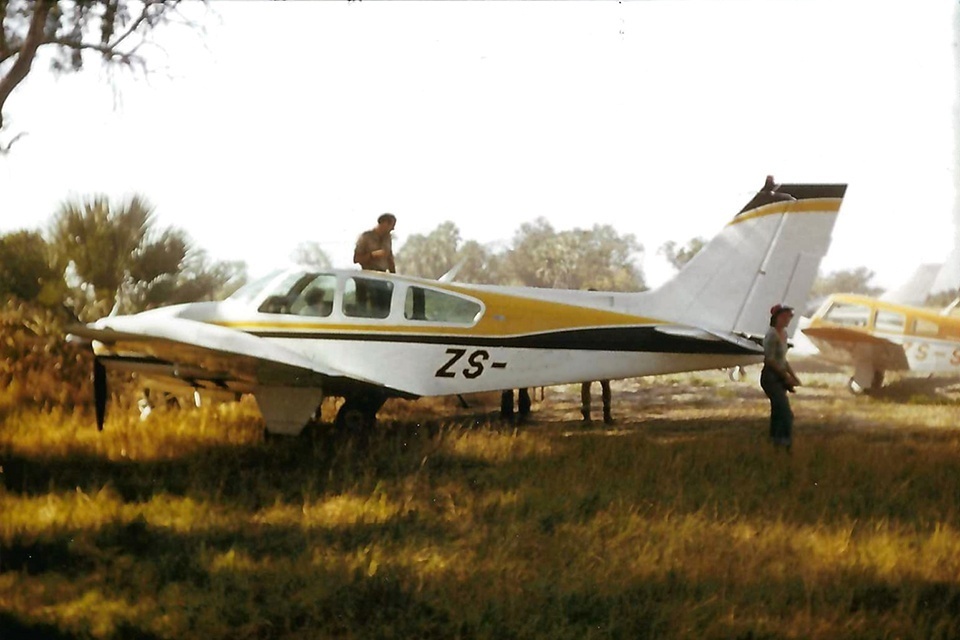
Flying in a private plane back then, was a real adventure that got under your skin.
Why a stopover and not straight to the destination? Surely the twin-engine Beechcraft Baron 55 had enough fuel to fly there and back.

The reason was quite different and it is good that I did know it before.

We started the two engines, rolled down the airstrip and took off. We had to fly a little circle and I, as »co-pilot«, had to watch exactly the moment when we would fly over the control tower of the Maun airfield. Then I had to press the button of our Swiss stopwatch and to tell the pilot when we would reach 12 minutes. We flew by time and compass.

11 minutes 50, 51, 52… 12 minutes.

Both of us looked out the little windows and searched, we searched for a natural airstrip. We screened the area like if we were looking for a flea with a magnifying glass. Somewhere down there it had to be. Suddenly relief, there it was, the small sandy track with the camp next to it, we found it!

Never had a twin-engine aircraft landed there. The runway made from sand and short gras was short, very short. There was water at the beginning and water again at the end, which meant Pierre had to start right at the beginning and brake before the heavy plane reached the end of the natural and rough runway.

To cut the story short, everything went great, but we still sweated.

The camp was simple, one main tent with the kitchen and supplies as well as a dozen tents with two comfortable beds each, an open cupboard to hang some clothes and the most important thing: a huge mosquito net over the beds. Electricity came from a generator and was available only during a few hours for dinner and in the morning.
The peace embraced me and I was back in my element, I was one with nature.

– Continuation:
How the escapades of a tourist almost spoiled my wilderness adventure